
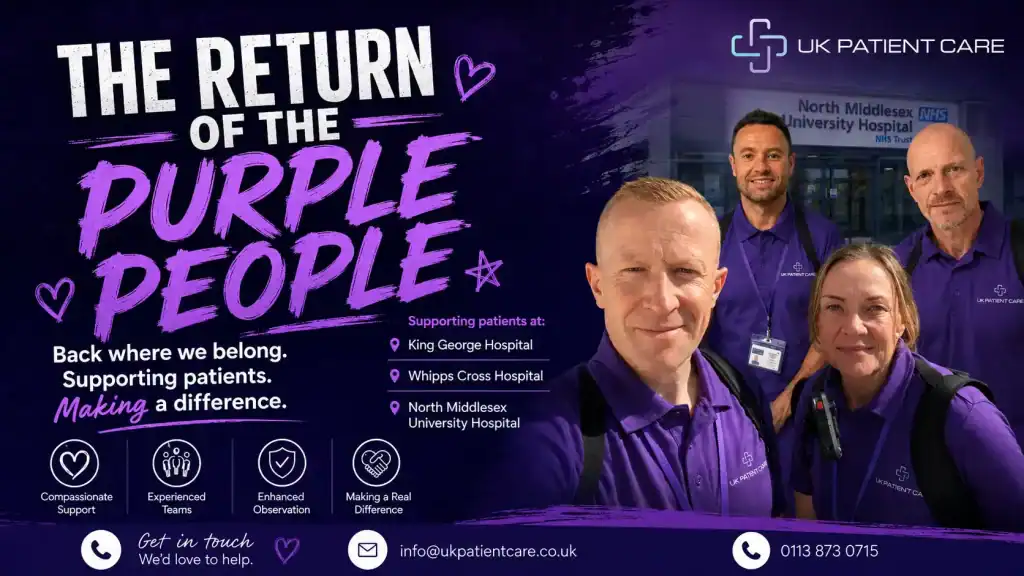
Over the last four weeks, our teams have been supporting hospitals in and around London, including North Middlesex University Hospital, King George Hospital and Whipps Cross University Hospital, as well as hospitals closer to home, including St James’s University Hospital and Leeds General Infirmary.
Whipps Cross University Hospital
King George Hospital
North Middlesex University Hospital
Alongside our work with hospitals, we have also been supporting local authorities who have been facing significant challenges in finding appropriate placements for some young people.
In these situations, our role is to provide safe, compassionate and professional support while longer-term arrangements and appropriate placements are identified.
The Purple People Are Back
There is something quite distinctive about a UK Patient Care team arriving on a ward.
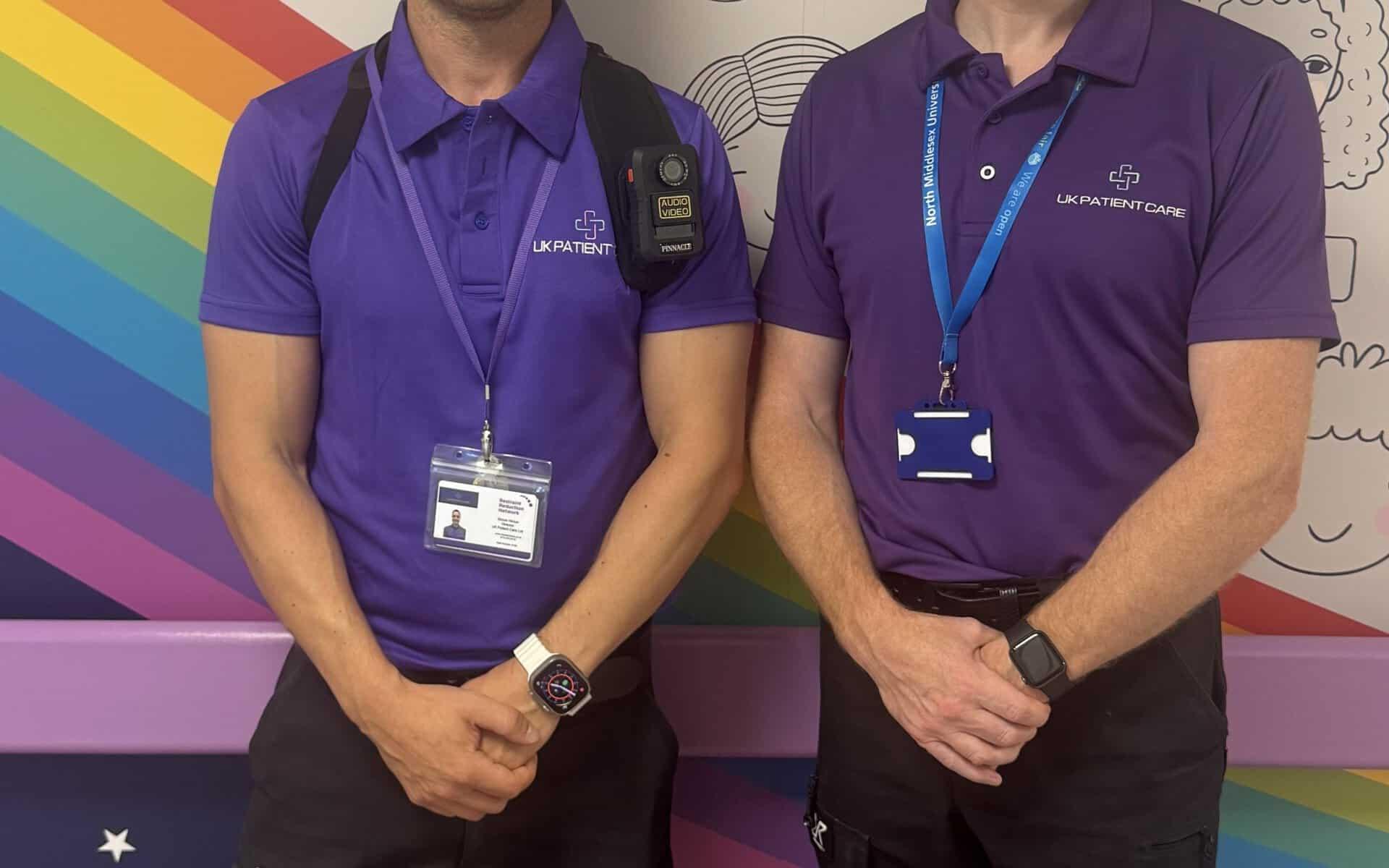
We wear purple.
Over time, we have become accustomed to hearing staff say:
“The purple people are back.”
For us, that phrase means much more than recognising a uniform.
The purple has become associated with safety, compassion, professionalism and a can-do attitude.
It means that when our teams arrive, people know we are there to help.
We understand the pressures faced by hospitals and healthcare teams. We know that wards can become extremely challenging environments, particularly when staff are dealing with distressed patients, aggression, incidents of violence, staff shortages and the additional demands that can come with supporting young people with complex needs.
Our approach is to arrive with a positive attitude, work alongside existing teams and find practical solutions to difficult situations.
We don’t arrive simply to observe.
We arrive to support.
More Than Patient Bed Watching
Patient bed watching is sometimes viewed simply as having someone present with a patient.
In reality, effective patient observation and therapeutic engagement require much more.
Our teams provide a consistent, skilled presence around the patient, focusing on understanding behaviour, identifying triggers, building rapport and helping patients to regulate when they are distressed.
This is why we see patient bed watching as much more than simply watching.
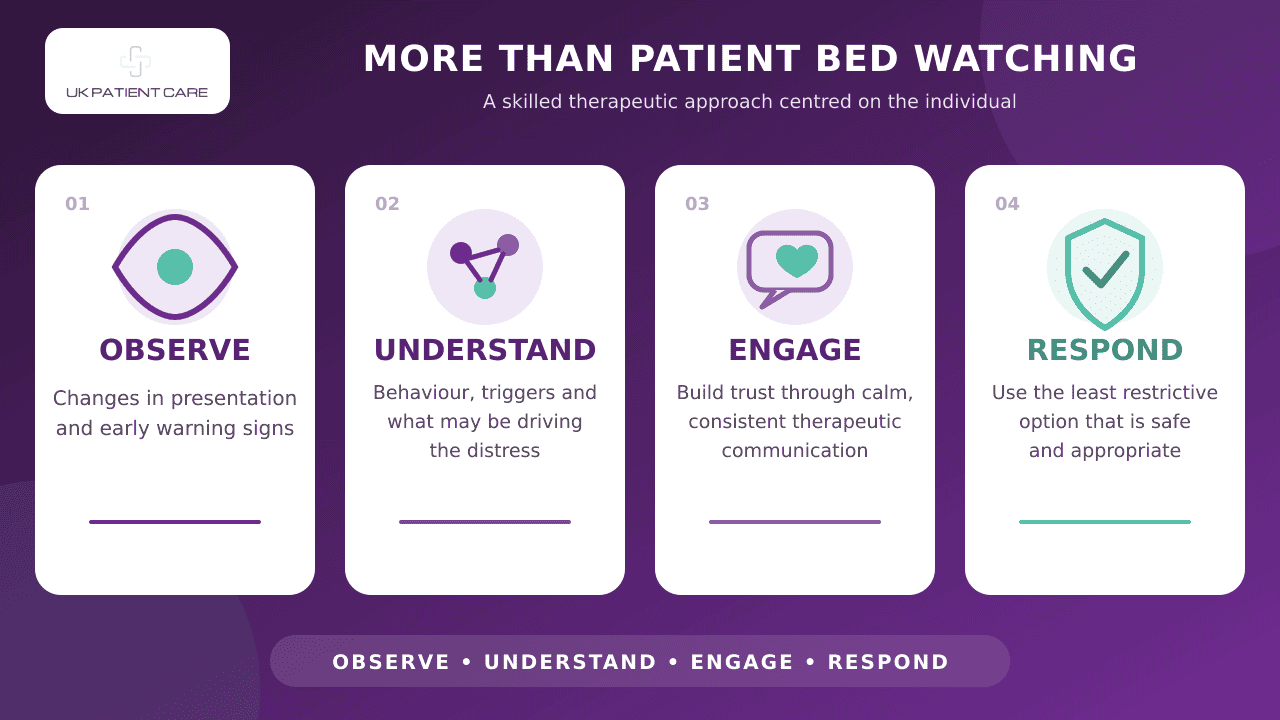
It is about observing, understanding, engaging and responding.
A skilled observer can recognise changes in presentation, identify early warning signs and understand when a patient may be becoming increasingly distressed.
Through therapeutic engagement, our teams can provide reassurance, establish trust and help patients feel safer.
The aim is not simply to manage behaviour.
It is to understand what the behaviour may be communicating and identify the most appropriate response.
A Trauma-Informed Approach
Many of the young people and patients we support have experienced trauma, difficult life circumstances or previous negative experiences within healthcare environments.
A trauma-informed approach means recognising that behaviour can be a form of communication.
Rather than immediately responding to behaviour with restrictive interventions, our teams look at what may be driving the distress and what can be done to reduce it.
This can involve building a trusting relationship, using therapeutic communication, identifying triggers and early warning signs, supporting emotional regulation and maintaining dignity and personal space.
It also means working closely with clinical teams and considering the least restrictive option at every stage.
For young people in particular, trust can be critical.
Sometimes the difference between escalation and de-escalation is having someone who is calm, consistent and willing to spend time understanding the individual.
When Safety Is at Risk
Recently, we supported patients whose behaviour and levels of displayed aggression had previously resulted in restraint and sedation.
When we arrived, staff had already experienced assaults, colleagues were off sick and the ward was under significant pressure.
The priority was to help create a safer environment for both patients and staff.
But our approach was not simply to prepare for the next incident.
We wanted to look at how we could support the patient therapeutically while reducing the need for restrictive practice wherever it was safe and clinically appropriate to do so.
This is where preparation, prevention and the appropriate use of specialist equipment became important.
Implementing a Safety Pod Strategy
We implemented our Safety Pod strategy, strategically positioning two pods on the ward so that one was always close by.
This meant that staff were not having to locate equipment during an escalation.
The equipment was already part of the environment and the team understood how it could be used.
We briefed the teams, established clear roles and ensured everyone understood what to do if the patient’s behaviour escalated.
The Safety Pod and Support Cushion were available as tools within a wider therapeutic and least restrictive approach.
They were not being used as a replacement for skilled staff or clinical decision-making.
The objective was to give the team additional options and, where possible, create an alternative to more restrictive interventions.
What happened over the following four days demonstrated the potential impact of that approach.

Day 1: Reducing the Duration of Restraint
On the first day, the patient’s behaviour escalated and restraint was required.
However, the intervention was brief.
The Safety Pod and Support Cushion helped the team manage the situation safely and significantly reduced the duration of the restrictive intervention.
This was an important starting point.
The objective was never to suggest that restrictive intervention would never be required.
The objective was to reduce its use, duration and intensity wherever it was safe and appropriate.
Day 2: The Safety Pod Without Medication
On the second day, the patient’s behaviour escalated again.
This time, we supported the patient onto the Safety Pod.
The patient was held safely, but the Support Cushion was not required.
Importantly, medication was not required.
The Safety Pod provided a safe environment in which the patient could be supported through the escalation without progressing to the same level of intervention experienced previously.
This represented a clear step forward in reducing restrictive practice.
Day 3: Moving Towards Therapeutic Engagement
On the third day, the patient’s behaviour escalated again.
However, the response continued to change.
Our team sat with the patient on the Safety Pod and held their hand.
The intervention had moved further away from simply managing behaviour through physical restriction and towards therapeutic engagement, reassurance and human connection.
The patient was being supported to remain safe while having someone alongside them rather than simply being subjected to a restrictive response.
The Safety Pod was becoming part of a familiar and safer environment in which the patient could begin to regulate.
Day 4: The Patient Chose the Safety Pod
By the fourth day, we saw the most significant change.
The patient was beginning to self-regulate and independently chose to sit on the Safety Pod without being held.
There was no requirement for physical restraint.
The patient had moved from requiring intervention to making their own choice to use the environment that had been introduced to help them feel safer.
This progression demonstrated a significant reduction in restrictive practice following the implementation of the Safety Pod strategy.
The journey was clear:
Restraint and Support Cushion.
Then Safety Pod with reduced restraint.
Then Safety Pod without medication.
Then therapeutic engagement on the Safety Pod.
Then independent use of the Safety Pod by the patient.
This is what least restrictive practice can look like in action.

The Goal Is Not Simply to Manage Behaviour
The aim isn’t simply to manage behaviour.
It is to reduce injury, reduce trauma, preserve dignity and create an environment where patients can begin to regulate themselves safely.
Every patient is different, and there is no single intervention that will work for everyone.
However, the principle remains the same.
Where it is safe and clinically appropriate, we should always be looking for opportunities to move towards the least restrictive option.
Sometimes the most effective intervention is not another restrictive measure.
It can be a calm voice.
A familiar face.
Patience.
Reassurance.
A consistent approach.
Or simply someone willing to sit alongside a patient during an extremely difficult moment.
The Importance of Therapeutic Engagement
Therapeutic engagement is at the heart of our approach.
For us, engagement means more than conversation.
It means taking the time to understand the individual, recognising what may be causing distress and identifying what helps them to feel safe.
For young people, this can be particularly important.
A young person who is frightened, overwhelmed or struggling to communicate may express that distress through behaviour.
Understanding what sits behind that behaviour can change the way we respond.
Rather than immediately asking, “How do we control this behaviour?”, we can ask, “What is this person communicating, and what can we do to help?”
That change in perspective can be significant.
The Role of Specialist Equipment
The Safety Pod and Support Cushion are not replacements for therapeutic engagement, skilled staff or clinical decision-making.
They are specialist tools that, when used appropriately alongside trained staff and a clear clinical approach, can help create safer environments and reduce the need for more restrictive interventions.

The equipment is only one part of the approach.
The people using it, the preparation beforehand, the understanding of the individual and the way the intervention is delivered are equally important.
We continue to see a lack of awareness and understanding of Safety Pod strategies across acute hospital environments.
There is a real opportunity to improve knowledge, training and access to appropriate equipment so that teams are better prepared when challenging situations arise.
From Crisis Management to Prevention
Effective patient observation should not simply mean waiting for something to happen.
It should involve recognising what might happen next.
That means looking for changes in presentation, communication, body language and behaviour.
It means understanding individual triggers.
It means knowing what helps a patient to calm down.
And it means having a plan that everyone understands before a situation escalates.
This is why preparation is so important.
By having trained staff, clear roles, appropriate equipment and an agreed approach, teams are better positioned to respond proportionately when a situation develops.
Supporting Hospitals Under Pressure
Hospitals are operating under enormous pressure.
Staff are often managing complex patients alongside significant operational challenges, staffing pressures and competing demands.
When incidents occur, the impact can extend beyond the individual patient.
Other patients can become distressed. Staff can be injured. Colleagues may need time away from work. The wider ward environment can become unsettled.
Our teams provide additional support during these challenging periods.
We work alongside existing clinical teams, providing specialist observation, therapeutic engagement and practical support while maintaining a focus on patient dignity and safety.
Our objective is to complement the existing team, not replace it.
Supporting Local Authorities and Young People
Our work also extends beyond hospitals.
Local authorities are increasingly faced with difficult decisions when trying to identify suitable placements for young people with complex needs.
There can be situations where an immediate safe solution is required while a longer-term placement is found.
Our teams can provide additional support during these periods, working with professionals to create a structured, safe and compassionate environment for the young person.
We understand that these situations are about more than managing risk.
They are about supporting a young person who may already be experiencing uncertainty, distress and significant change.
A trauma-informed approach is therefore essential.
Building Trust Through Consistency
One of the most important aspects of therapeutic engagement is consistency.
Patients who are distressed can find unfamiliar faces, changing approaches and unpredictable environments difficult to manage.
Our teams understand the importance of building familiarity.
A calm approach, clear communication and consistent boundaries can help create an environment where a patient begins to understand that the people around them are there to support rather than control them.
This can take time.
But small changes can be significant.
A patient accepting reassurance.
A patient choosing to engage.
A patient recognising the Safety Pod as somewhere they can go when they feel overwhelmed.
A patient who previously required physical intervention beginning to regulate independently.
These are the moments that matter.
Why the Purple Team
“The purple people are back.”
It is something we hear regularly when our teams return to a hospital.
For us, it represents trust.
It means staff know who has arrived and what they can expect from us.
They know we will come onto a challenging ward with a positive attitude.
They know we will work with their teams.
They know we will look for solutions.
And they know that our priority is the safety and dignity of the patient as well as the safety of those caring for them.
The purple represents much more than a uniform.
It represents safety.
It represents compassion.
It represents professionalism.
And it represents a can-do attitude.
Our Patient Bed Watching and Observation Services
UK Patient Care provides specialist support for patients who require enhanced levels of observation, engagement and care.
Our services include:
Patient bed watching
Enhanced patient observation
Therapeutic observation
Therapeutic engagement
Support for young people with complex needs
Trauma-informed support
De-escalation and behavioural support
Additional staffing during periods of heightened risk
Support for hospitals experiencing significant operational pressure
Support for local authorities while appropriate placements are identified
Specialist equipment strategies, including the Safety Pod and Support Cushion
Our teams work alongside existing clinical and care professionals, adapting our approach to the needs of each individual patient and the environment in which we are working.
Safety Should Start With Preparation
Our recent experiences continue to reinforce a simple principle.
Safety shouldn’t start with restraint.
It should start with preparation, prevention, therapeutic engagement, skilled observation and the least restrictive response possible.
When hospitals and local authorities are under pressure, having access to experienced specialist support can make a difference.
When a young person is distressed, having someone who understands how to engage with them can make a difference.
And when a ward is facing repeated incidents, having the right people, training, preparation and equipment available can make a difference.
That is what UK Patient Care is here to provide.
So when you hear:
“The purple people are back.”
We hope it means one thing.
Help has arrived.
Therapeutic. Least restrictive. Compassionate. Safe.
UK Patient Care — specialist support when it matters most.
For more information visit our webpage here https://ukpatientcare.co.uk/patient-bed-watch/